
Key takeaways
- “Waterproof” means the planks, not the floor. Vinyl planks can shed water on top, but water still runs through seams and edges and gets trapped underneath.
- The subfloor has to dry too. The EPA says the subfloor under carpet or other flooring must also be cleaned and dried after water damage.
- Laminate is less forgiving than vinyl. Laminate has a wood-fiber core that tends to swell for good once it soaks up water.
Words you’ll see
- Luxury vinyl plank (LVP)
- Plastic-based planks printed to look like wood. Many are sold as waterproof, which means the plank itself won’t swell.
- Laminate
- Planks with a pressed wood-fiber core under a printed photo layer. The core can swell and soften when it gets wet.
- Click-lock
- Planks that snap together at the edges instead of being glued down. They can often be unclicked and lifted, starting from the edge of the room.
- Underlayment
- A thin foam, cork, or felt pad under the planks. Many vinyl planks have one attached to the back. Some hold water like a sponge.
- Subfloor
- The plywood, OSB, or concrete layer the flooring sits on.
- Peaking
- Plank edges that rise into a ridge at the seams, a common sign of water in laminate.
On this page
How can I tell if there’s still water under my floor?
Look and feel along the seams, and smell near the floor. The top of a vinyl plank can look perfect while water sits underneath, so the clues are usually at the edges, not in the middle of a plank.
A moisture meter can confirm what’s going on, but a reading on top of a vinyl plank doesn’t always reflect what’s underneath. The surest check is to lift a few planks near the leak and look at the subfloor.
Should I pull up the floor to check?
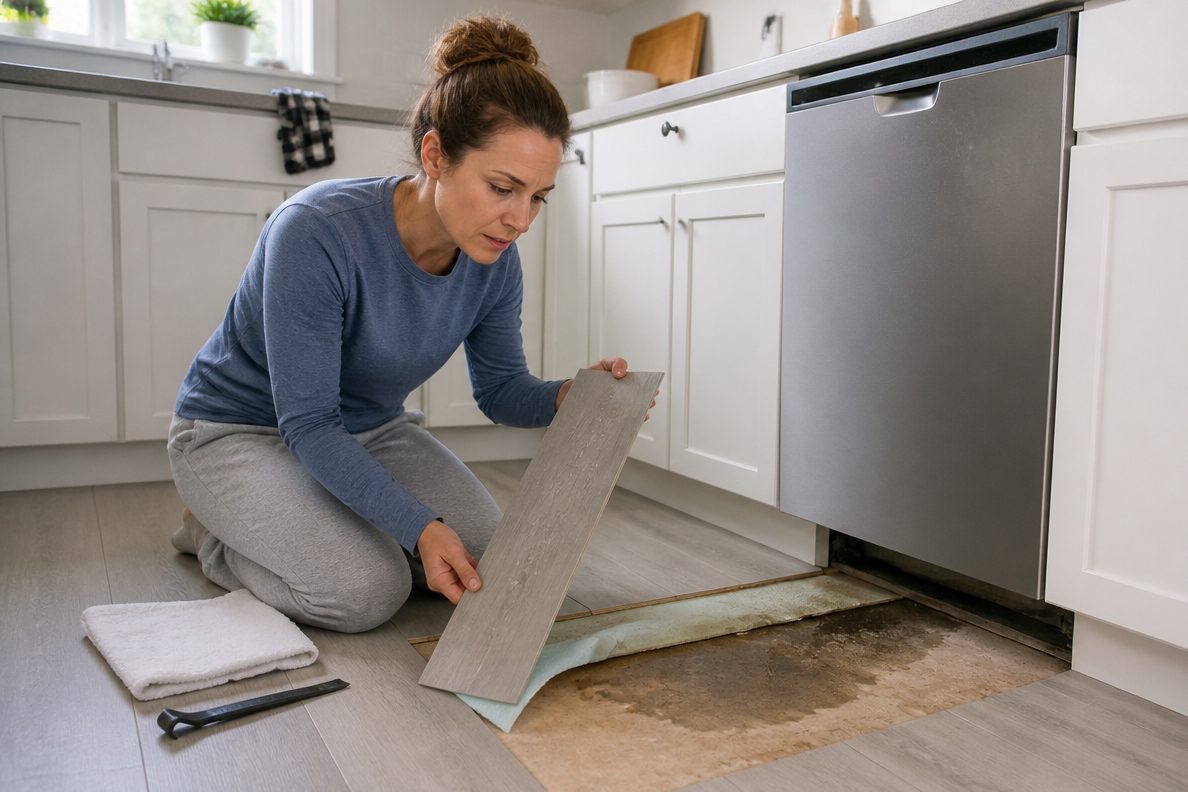
Often, yes, at least a few planks near the leak. Click-lock planks usually come up from the edge of the room, after you take off the baseboard or quarter-round trim. They can’t be popped up from the middle of the floor without damaging them.
- Take photos before you start, and number the planks on the back if you hope to reuse them.
- Start at the wall closest to the leak if you can. Depending on how the planks lock, they may come apart more easily from one side of the room. Remove the trim, then unclick the planks row by row.
- Look at the underlayment and subfloor. Dark, damp, or soft spots show you how far the water spread.
- If the planks are glued down, or you can’t lift them without breaking the edges, stop and call a pro. Do the same if you find older sheet vinyl or tile underneath, since some older flooring and glue contain asbestos.
- If the water came from a toilet bowl, a backed-up drain, or outside, wear gloves and leave the cleanup to a pro.
Can wet vinyl plank or laminate flooring be saved?
Vinyl planks often can be saved. Laminate often can’t. What matters most is whether the planks themselves swelled, and whether the subfloor underneath can be dried.
Any flooring soaked by sewage, a backed-up drain, or outdoor floodwater should be treated differently. In those cases the planks and underlayment are usually removed, not dried. Our guide on what to throw away after a flood explains why.
How do I dry the floor and subfloor?
Get air to the subfloor. That usually means lifting the planks in the wet area. The EPA’s water damage guidance says the subfloor under carpet or other flooring must also be cleaned and dried, and it points to a 24-to-48-hour window to respond to water damage.
- 1
Open it up
Lift the planks and remove wet underlayment in the area that got wet, plus a little beyond it. Lay planks you hope to reuse flat, with spacers between them, so air reaches both sides.
- 2
Move air and pull out moisture
Point fans across the subfloor and run a dehumidifier with the windows and doors closed. Empty the dehumidifier often.
- 3
Check it before you close it up
Don’t put the floor back until the subfloor reads about the same as a dry part of the same floor on a moisture meter. A restoration company usually measures this and keeps a written drying record.
Will insurance pay to replace my floor?
Possibly, if the leak was sudden. It often depends on what caused it and how long it went on. According to the NAIC, homeowners policies generally cover damage from a “sudden and accidental” discharge from a plumbing system, like a pipe that bursts. The insurance regulator in neighboring Washington State, the Office of the Insurance Commissioner, which publishes a plain-English guide on this, notes that most homeowners policies don’t cover gradual leaks that go on for a long time. Policies vary, so check yours or ask your agent.
That matters for floors, because water under planks is often found late. Report it as soon as you find it, take photos before you pull anything up, and keep a few damaged planks and receipts. If the floor runs into other rooms and new planks won’t match, ask your insurer how they handle that.
Our step-by-step guide to water damage claims in Idaho walks you through the process.
Who should I call about water under my floor?
Call a plumber or appliance tech to stop the leak, and a water damage restoration company if the subfloor is wet or the water spread under more than a few planks.
If the leak came from a dishwasher, our guide on a dishwasher leaking under the floor has more detail. If it reached the ceiling below, see what a brown water stain on the ceiling means.
Frequently asked questions
Isn’t vinyl plank flooring waterproof?
The planks themselves usually are, but the floor isn’t sealed. Water runs through the seams and along the edges and can sit on the subfloor underneath, where it dries very slowly.
How long does it take water under a floor to dry?
It depends on how much water there was, the type of subfloor, and whether the planks were lifted. Left covered, it can stay wet for weeks. With the planks up and fans and a dehumidifier running, it often takes a few days. Concrete can take longer.
Can I just leave it and hope it dries?
It’s risky. Trapped water can lead to mold, a musty smell, a soft subfloor, and planks that won’t lock back together. At the very least, lift a few planks to check.
Will my laminate go back to normal once it dries?
Usually not if the seams have swollen or peaked. The wood-fiber core tends to stay swollen. Laminate that got wet but didn’t swell may be fine if it was dried quickly.
Can I reuse vinyl planks after taking them up?
Often, if they’re click-lock, the locking edges aren’t damaged, and they were wet with clean water. Dry and clean them, and only put them back once the subfloor is dry.
Water under the floor is easy to miss and easy to underestimate. A few planks lifted now can save the whole floor later.
Call if the floor is soft or squishy, the water spread under several rooms, or it reached the ceiling below, and we’ll try to connect you with an independent water damage provider near you.
Read next

Related guides
Sources (checked November 14, 2026)
- US EPA, “Mold Remediation in Schools and Commercial Buildings Guide: Chapter 4” (Table 1): https://www.epa.gov/mold/mold-remediation-schools-and-commercial-buildings-guide-chapter-4
- NAIC, “Will My Homeowners Insurance Policy Cover Water Damage From a Burst Pipe?”: https://content.naic.org/article/will-my-homeowners-insurance-policy-cover-water-damage-burst-pipe
- Washington State Office of the Insurance Commissioner, “Leaks, water damage, and mold”: https://www.insurance.wa.gov/insurance-resources/home-insurance/how-home-insurance-works/leaks-water-damage-and-mold
Update log
- November 14, 2026: First published.